

Commonality – Public communication news from Cap’Com
A new chapter is opening for the French network for local public communication. After more than three years of publishing articles in English, Cap’Com has launched its own LinkedIn newsletter – and uncovered a whole new audience. Designed to exchange good practices and explore emerging trends, the content aims to build a shared culture of public communication that extends well beyond national borders.
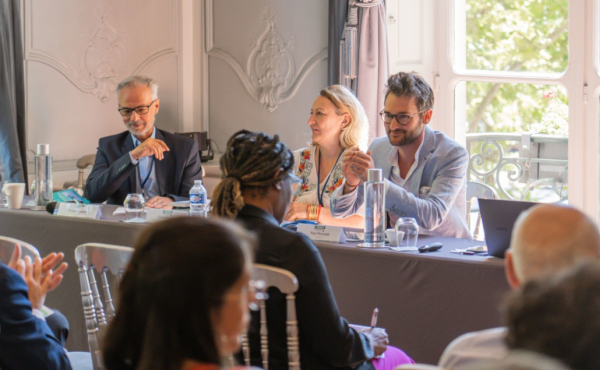
Back in spring 2022, as Cap’Com held its first joint seminar with the Club of Venice in Toulouse, our very first English-language articles went live. This decision stemmed from four key observations:
- Cap’Com had long collaborated with international organisations, such as the OECD, ICMPD and the Club of Venice, on local public communication issues, and maintained strong ties with peer networks in Italy, Belgium and Canada;
- We used English for much of this dialogue, since it remains the easiest language for global understanding – even if we always provide simultaneous translation at international events;
- We saw how often the topics covered in our newsletter, presentations and conferences sparked interest across borders;
- And our bi-monthly newsletter Point commun, with its 20,000 subscribers, regularly featured editorial content that deserved to be shared outside France and the francophone world.
So we began by translating articles from our international seminar, Citizenship and Participation in Regions (Toulouse, 16-17 February 2022). Then we translated previously published French articles on international issues and finally, started creating original content directly in English.
Today, more than 60 of these articles are available on our website in the “English reading” section.
A convergence of concerns
But the story doesn’t end there. Over the past few years, we felt our concerns increasingly converging – shaped by:
- The Covid-19 health crisis and its social repercussions;
- The rise of misinformation campaigns and attempts to manipulate public opinion, amplified by globally-shared digital practices;
- Systematic attacks on democratic institutions;
- A shared recognition that certain groups were drifting away from what forms consensus and society, alongside increasingly volatile, fatigued public opinion and the emergence of alternative ‘reality bubbles’;
- And, everywhere, a heightened focus on accessibility, literacy and now the challenges posed by artificial intelligence.
We then became firmly convinced that each of us, in our own local context, holds a part of the solution in terms of public communication.
It was a time defined by crises and emergency situations – unfolding against the backdrop of armed conflicts resurfacing close to home – as well as global, borderless challenges such as climate change. We then became firmly convinced that each of us, in our own local context, holds a part of the solution in terms of public communication. And this breaking down of borders applies not only across cultures and nations, but also between small municipalities and large regions. Whether in a valley, a small town, a neighbourhood, or on the scale of a region or a country, we are often dealing with the same questions. We strive, in similar ways, to build public trust, uphold the authenticity of facts and ensure transparency in public action. These past four years have shown that local, personal, day-to-day communication – grounded in direct human relationships – can be remarkably effective and, in some cases, help rebuild strained ties between citizens and institutions. This is our core belief at Cap’Com and we regularly place the communication efforts of large authorities on the same footing as the initiatives coming from what we affectionately call our ‘Little Thumb’ municipalities.
All our articles are translated by professional translators
Since the launch of Commonality, published twice a year, we have developed a clear method for producing and translating our content. We partnered with the translation and interpretation agency Into-nations, with which we’ve built a long-term, trusting relationship. Together, we have developed a professional lexicon and refined the quality of writing to be both technically precise and human, with a style and editorial stance that stand apart from standard AI-generated content. This collaboration took a unique turn last year with the translation and publication of a remarkable book by our colleague Klimentini Diakomanoli, whom we met at a Club of Venice seminar in London, just as she had published an excellent work in Greek through the University of Macedonia Press, focusing on her area of expertise, namely Europe’s fight against misinformation. Cap’Com negotiated the rights, found a French publisher (L’Harmattan), and funded the translation of the text. Adapted and enriched with notes, the book was presented at our international seminar in Strasbourg on 23-24 May, 2024.
Choosing a new platform
Nevertheless, we were not fully satisfied with the reach of our newsletter in its original format. Subscribing was still too dependent on the francophone sphere and on individual goodwill, since we could only recruit readers through recommendations. Our thinking was strongly influenced by our Belgian colleagues from the Wallonia-Brussels communication delegation, who told us about their new London-based newsletter published on LinkedIn. So, in the summer of 2025, we decided to migrate to this professional network – a platform where Cap’Com already has over 44,000 followers and which seemed like the perfect crossroads to give Commonality a wider audience.
Within days, our subscriber numbers climbed into the thousands, eventually reaching 9,000 today.
In September, we published the first issue in this new format (the eleventh issue overall). The goal was both to win back the previous subscribers to Commonality and to attract new ones – which we achieved very quickly, surpassing our previous reach within just a few hours. Within days, our subscriber numbers climbed into the thousands, eventually reaching 9,000 today. What a surprise – and what a joy, in light of the tireless efforts of our dedicated team over the past three-plus years. We naturally want to thank all our partners who have supported us and helped us identify relevant topics (notably the Club of Venice), as well as everyone who has taken an interest in subscribing to this new format.
For them, and for future readers of Commonality, we created a communication campaign with the slogan, ‘Because baguettes are not the only thing worth sharing. Practices of local public communication too!’ This is a fun way of highlighting our identity and local public communication culture, while emphasizing openness, dialogue and sharing – all grounded in solidarity and ethical principles. After all, we are a cooperative working for the public interest, facilitating a professional network of administrations and bodies that see public communication as a true public service. The professionals we serve are the audience of Commonality, wherever they may be, for whom we will henceforth be publishing this newsletter quarterly, featuring a variety of articles on trends and best practices in our field (all available in both English and French).
Commonality is a newsletter for public communicators in all countries, particularly in Europe – and it’s created with their input. Each quarter, an editorial committee determines the content based on current events. Any public communication professional can propose contributions for publication (contact: communication@cap-com.org). Let’s share both our practices and our perspectives!