

Public communicators, the new storytellers of our collective narrative
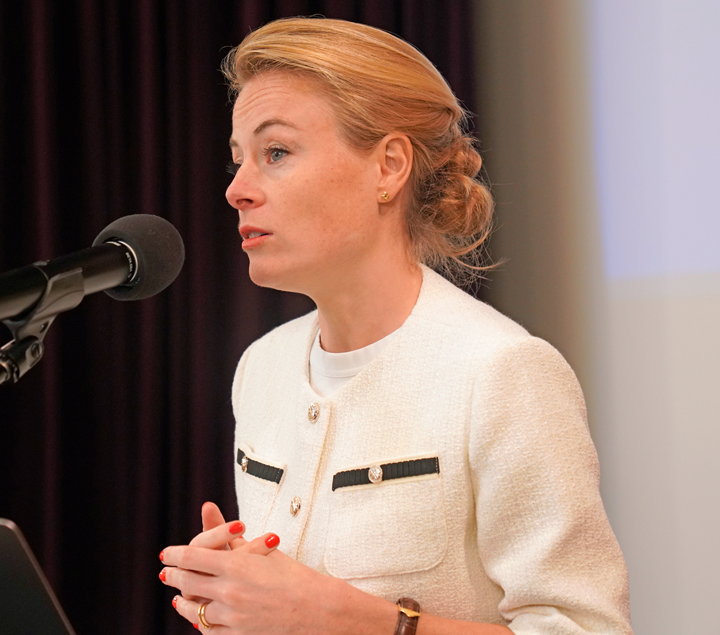
Philosopher and author Emma Carenini explores the power of storytelling in our fragmented societies. For her, telling a story isn’t just an art of expression – it’s a way to shape the world. In this interview, she discusses the role of the public communicator as a modern “griot” – a contemporary storyteller, inspired by the West African tradition, who preserves collective memory and rebuilds social bonds through narrative and a deep understanding of reality. It’s a reflection on the power of the ‘meta-narrative’, at the intersection of mythology, truth and action.
Emma Carenini is an associate professor of philosophy, co-founder of Phronimos, and author of Soleil. Mythes, histoire et sociétés (PUF). She previously served as adviser on speeches and arts and cultural education in the office of the French Minister of National Education and Youth. Her research partly focuses on the concept of the commons, the role of storytelling in contemporary societies and the relationship between truth, emotion, and action – topics that led to her invitation to deliver the opening plenary at the 37th Cap’Com Forum in Angers. She also addressed the Cap’Com Steering Committee on 2 October 2025 in Paris, where she discussed how narratives shape our social bonds and restore meaning to public discourse.
Commonality: What role do public communicators play in shaping this meta-narrative, at a time when budgets are shrinking and public communication is increasingly sidelined?
Emma Carenini: The role of public communicators is immense. One way to understand their function is to compare them to ‘griots’, the traditional storytellers of certain African societies, who intervene precisely when a community is facing a crisis or experiencing a fracture. Their task is to remind people of their shared history, as well as reactivating the foundational meta-narrative that justifies collective existence and explains why these individuals form a community.
Contemporary public communicators perform a similar role. They have technical mastery of storytelling and possess a ‘narrative capital’ that allows them to organise facts, shape them effectively and choose the right images to convey their message. This skill becomes all the more crucial as the ways people receive messages are constantly changing. Public communicators thus become craftsmen of social cohesion through storytelling, able to create the symbolic glue every community needs. This aspect is not incidental: political regimes are built on narratives, as are advertising strategies. Collective imagination is nourished by these narrative constructions. From this perspective, public communicators hold a strategic position, acting with full awareness of these stakes.
Commonality: How do you see a collective narrative that isn’t personalised, but is embodied, so to speak, by a land or a territory?
Emma Carenini: The author of The Lord of the Rings created his work from a deep attachment to his territory and culture. He created a complete mythology, with a coherent system of characters, precisely mapped locations and stories nested within one another. His project explicitly aimed to create a territorial narrative, a new mythology for Anglo-Saxon culture. When a narrative emerges from a territory rather than individual ambitions, it reaches a mythological level. The mythos works directly on the collective imagination and seeks a universal rather than a particular resonance. This type of narrative transcends personal interests to touch on something more fundamental in our shared human experience.
Because it captivates people, history is an instrument of power.
Commonality: Telling a story can be highly positive. Everyone listens and we share and pass on emotions and common experiences. But we can also 'spin stories' and speak nonsense. Are these really just two sides of the same expression?
Emma Carenini: Let me tell you a personal story. When I sat the agrégation in philosophy, there was a topic for the oral exam: 'Spinning stories about ourselves'. This is a highly ambiguous topic, which I liked. I didn’t get it on the day, but I’m glad to be able to talk about it with you today. This ambivalence is indeed at the heart of the narrative problem. ‘Spinning stories about ourselves' perfectly captures this duality: it refers both to the fundamental human ability to create meaning through storytelling and to the tendency toward self-deception. This reflexive dimension – telling stories about oneself – introduces the possibility of deliberate deception and voluntary blindness. Nazism demonstrated the destructive power of instrumentalised narrative. The myth of a 'superior race' and of lebensraum rallied an entire people around a genocidal project. Stalin rewrote Soviet history, erasing his opponents from photographs and archives to construct a linear narrative of the revolution. These examples show how controlling the narrative becomes an instrument of total domination. The French 'civilising mission' or the British 'white man’s burden' legitimised colonisation by presenting domination as a benefit. These narratives allowed the metropoles to justify exploitation while maintaining a clear conscience. A society can very well tell itself stories to endure the unbearable. As Yuval Harari shows in Sapiens, the narrative capacity is a fundamental anthropological trait. But precisely because it so powerfully captivates individuals, it inevitably becomes a tool of power. This ambivalence requires constant vigilance. A narrative can liberate by giving meaning to experience, but it can also enslave by imposing fictions that serve particular interests.
Commonality: You mentioned in your talk the speaker who clings to reality to find a form of sincerity and authenticity. In this relationship to reality, especially in times of crisis, isn’t being able to acknowledge a vulnerability or a weakness also a form of strength?
Emma Carenini: I completely agree and I’d like to bring in a philosopher I greatly admire, Baruch Spinoza, who says something very simple: we are only free in life once we understand what is happening around us, in our own lives. I’m simplifying, of course, but that’s essentially his point. We only become free when we grasp the causal chain that produced a given situation – whether it’s a conflict, a difficult relationship or a local disaster. This understanding gives us leverage over reality because we can identify possible courses of action.
There is a link between narrative, truth and action.
Human beings never act outside nature or the causes that shape the world. If we understand these causes, we can act on them. Narrative then becomes a tool for clarification: it allows us to say, 'This is what happened, this is how we will tell it and these are the levers for action'. This approach creates the conditions for clear-sighted and effective action. Narrative thus establishes a direct link between truth, understanding and the ability to act. There is a link between narrative, truth and action.
Commonality: Do you see new meta-narratives emerging?
Emma Carenini: Ecological issues are the most obvious example, but this also reveals a worrying transformation. Unlike earlier periods that produced utopias (from Thomas More to Tommaso Campanella), our era seems unable to conceive desirable ideal societies. The utopian imagination has given way to dystopias, narratives of collapse and catastrophe. This shift also affects contemporary meta-narratives. The dominant ecological narrative presents humanity as moving along a path of destruction. This meta-narrative, although grounded in tangible realities, lacks the positive and mobilising dimension that characterised the great collective narratives of the past. We may be witnessing the emergence of structurally pessimistic meta-narratives, which raises the question of their ability to inspire engagement and collective action.
With AI, the issue goes beyond the proliferation of artificial narratives: it concerns humanity’s ability to retain control over its own symbolic production.
Commonality: Right now, there is another force emerging in narrative creation: AI.
Emma Carenini: Artificial intelligence is indeed creating a major disruption in the narrative economy. It is a text-generating force that is gradually colonising the narrative space, feeding on all the content available on the internet. We’re witnessing the emergence of an ecosystem where stories are produced by AI, reviewed by AI and then summarised for human consumption. This development has led some observers to propose the idea of a dead internet a network where all content, whether narratives, speeches or symbolic productions, is generated by algorithms. Beyond simple competition between narratives, this raises the question of human imagination being captured by technical systems. The issue goes beyond the proliferation of artificial narratives: it concerns humanity’s ability to retain control over its own symbolic production.