
AI, video, information overload… lessons from the Local News Festival
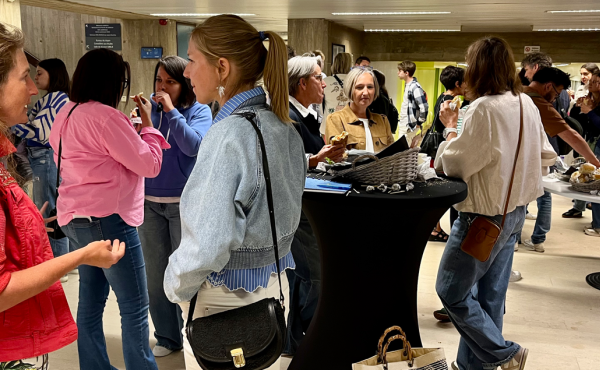
Every year, local media gather in Nantes for the Local News Festival (FIL) to share their insights and best practices. For territorial communicators – central players in their local media ecosystem – these two days are a treasure trove of inspiration. From hands-on insights on AI and video trends to the shifting landscape of local news, plus strategies to tackle information fatigue ahead of a major local election… we catch the “feel” of the 2025 edition to bring fresh ideas to local authorities.
The advantages of newsletters, Facebook, video and YouTube; the importance of personal presence; practical uses of AI; information overload; and the approach of local elections… In the corridors of the 2025 Local News Festival (FIL) in Nantes, the conversations echoed those from the Digital Communication Conference held in Rennes just a week earlier. Communicators from Rennes had even come to the FIL to share their best practices on improving digital accessibility. This year, however, the focus was on participants themselves: communicators from French départements, towns & cities and metropolitan areas – both from the Nantes region and beyond – gathering insights from local media use to refine their own practices and content. We bring you the “feel” and key takeaways from FIL 2025.
AI: leveraging content and saving journalists’ time
It’s no surprise that AI was once again a major focus, with several practical case studies and toolkits shared. A number of media outlets reported concrete applications in their newsrooms, allowing for optimisation and a faster response in handling content produced by their journalists.
For example, Ici (formerly France Bleu) uses AI to scan its 44 local morning broadcasts and provide the midday editorial team with content and eyewitness accounts. The process involves converting audio excerpts into text using an AI transcription tool, which is then integrated into NotebookLM (a research and note-taking platform). AI then analyses the content, making it possible, for instance, to locate a person’s testimony in one of the territories covered by Ici using timestamps. After a pilot on a health report in October 2024, the process was used live for the first time on 15 November 2024 to cover farmers’ demonstrations. It allowed the team to deliver firsthand accounts gathered in the morning directly to the Prime Minister, who appeared on the midday show, providing him with an up-to-the-minute nationwide situation report.
For the past two or three years, La Dépêche du Midi has been rolling out an AI Factory focused on three priorities:
- Improving quality (correcting and enhancing articles),
- Increasing efficiency: ensuring content is read, tracking whether an article retains readers, drives traffic or generates subscriptions,
- Saving journalists’ time, by offloading technical tasks.
This media outlet also uses NotebookLM, a tool created by a journalist at Google Lab who wanted to reuse all his paper and digital notes while preserving the quality and authenticity of his sources. By implementing all articles and notes produced since the start of the investigation leading to the trial for murder of Cédric Jubillar, La Dépêche journalists were able to write pieces with specific angles, even while the trial was in progress.
Open-source AI as an alternative
NotebookLM allows users to leverage their own knowledge base to generate podcasts, FAQs, timelines and more. Yet both Ici and La Dépêche remain vigilant, carefully checking AI-generated content to avoid transcription errors and, as with any other source, verifying the accuracy of testimonies before extracting audio for a broadcast, for example. Another concern stems from the tool’s association with Google: it’s currently free, but for how long? And what about confidentiality? For Ici, however, this isn’t an issue as regards radio broadcasts, which are all public and accessible online. NotebookLM claims to ensure strict user data confidentiality. User data isn’t used to train the AI and isn’t visible to other users, as it’s stored in a separate, isolated environment for each individual. However, it’s hard to know in which country the storage servers are located...
An alternative could lie in open-source solutions, such as Open Notebook. This is one of the tools included in the Opensource Essential AI Toolkit for Journalists and Content Creators presented from Quebec by Florent Daudens of Hugging Face, who works on helping journalists adopt AI tools. “No-code tools are easy to use. But after that, it’s important to start internalising skills and identifying potential collaborations between media groups, for example, to accelerate adoption.“ Yes, but “how do we get started?“ asked one participant. The answer came in four steps:
- Analyse how news is produced;
- Identify the non-editorial scope of each stage of production;
- Decide which tasks to handle with AI, while also considering confidentiality, security and ethical issues;
- Determine how humans can be kept in the loop.
Video: a winning strategy for local media?
This was the central question in a panel discussion bringing together several industry players. All emphasised the now-essential role of video, particularly for reaching younger audiences and giving more presence to the stories covered. They highlighted several effective formats:
- Vertical formats, especially shorts, which allow media outlets like Le Parisien to reach audiences who prefer this style on social networks;
- Long-form videos, which perform strongly, such as Kaizen by Inoxtag, which recently released a second film on YouTube;
- Filmed podcasts: even with just a still image, these are popular on YouTube. Video podcasts also allow extensive reuse of content through clips, teasers, etc.
The debate also highlighted a certain unease, namely a potential generational gap. “We need to hire young people who understand the codes of video, rather than sticking to traditional journalistic methods”, one panellist summed up. This comment illustrates the tension between established practices and new forms of use. The discussion also raised questions about the ethics of emerging media. A representative from an online video platform, after stating that “anyone can be a journalist”, explained that their teams sometimes produce short promotional clips designed to look like news content, blurring the line between commercial communication and journalistic production.
Local journalism: learning to listen to audiences again
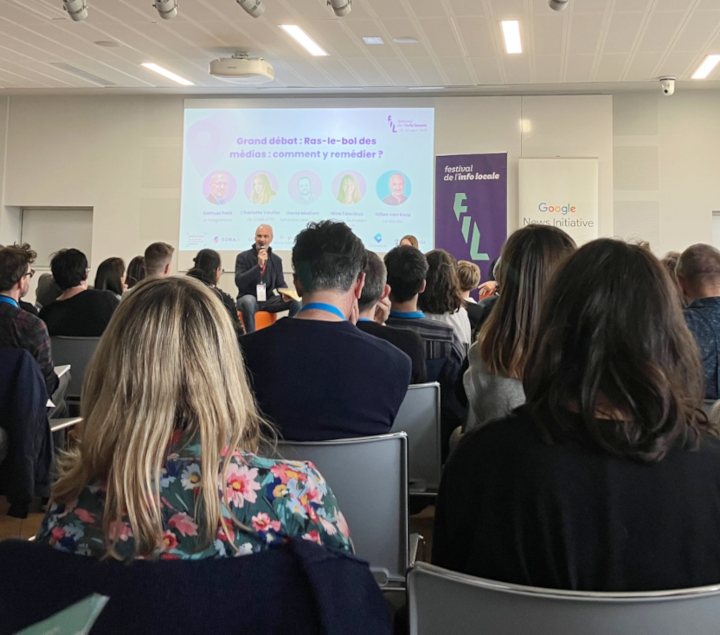
At the heart of the festival, a major public debate addressed the issue of ‘media fatigue’ or ‘information overload’, as theorised by the Jean-Jaurès Foundation in a study co-authored by David Médioni, who was present. Updating the study in early 2025, he observed a shift from fatigue to what he calls information exodus. “Some people have no problem living without following the news. The reality they believe in isn’t shaped by information. [...] They think they’re informed, but don’t actually understand anything”, he explained. “40% of people avoid news to some degree, according to Reuters”, confirmed Gilles van Kote, Deputy Director for Reader Relations at Le Monde and moderator of the debate. “The rest feel overwhelmed and powerless.”
David Médioni identifies three key pillars for solutions:
- Individual: carry out a ‘news carbon audit’;
- For media and formats: work on timing, alerts newsletters and social media control. “According to the Jean-Jaurès Foundation study, the least fatigued read Le 1, the morning edition of Le Monde or the Brief.me newsletter”;
- Reasoned public communication: avoid automatically going on TV talk shows and steer clear of sensationalism.
And more broadly, he suggests:
- Starting a campaign to raise awareness about consuming less news;
- Introducing media literacy modules in schools from age 8 through to 18;
- Finding ways to ensure that all platforms and AI tools are held to the same obligations as traditional media.
Journalism is, at its core, about connecting people. The question is: do you build a barrier or a bridge?
Nina Fasciaux, Director of Partnerships at the Solutions Journalism Network
For Charlotte Vautier, an independent journalist and content creator, many journalists tend to talk primarily among themselves, which can lead to missed media opportunities. “We need to put ourselves in the readers’ shoes”, adds Samuel Petit, editor-in-chief of Le Télégramme. “When you know who you’re talking to (and data gives us that knowledge), you can ask yourself what they actually want.”
For Nina Fasciaux, Director of Partnerships at the Solutions Journalism Network, “journalists have stopped listening”. She first observed this after Trump’s ‘surprise’ election and again during the Yellow Vest protests. However, “this doesn’t mean sugarcoating things. But it’s about listening to the real suffering behind what’s going on, which is the feeling of powerlessness […]. Local journalism has a superpower, namely its proximity. Journalism is, at its core, about connecting people The question is: do you build a barrier or a bridge? When you give someone a voice or write about them, you show that they matter. […] Yet you still have to choose your words carefully, and behavioural science helps us understand how those words are received.”
Local elections: what content sparks interest?
With local elections just months away, coverage of the vote, known as the “Olympics of local journalism”, was a major topic at this year’s festival.
To capture readers’ attention, local media often focus their reporting around a simple, concrete question: what will change if this candidate is elected? This approach can take several forms, such as interviewing candidates directly about their plans, or tracking and verifying whether promises made by the current officeholders since the 2020 elections have been fulfilled.
Beyond campaign coverage, there’s also a need for educational reporting. Indeed, journalists have a crucial role to play in explaining the powers of a municipality and its intercommunal structure, as well as any new rules governing the election.
Médiacités has leveraged artificial intelligence to analyse all council resolutions in several major cities where the outlet operates, in order to create a clear, concrete dashboard of decisions made by elected officials. This analysis highlights the main themes under discussion, identifies potentially overlooked neighbourhoods, and sheds light on all the actors involved.
Panellists were unanimous in stressing that fair treatment of all candidate lists remains essential.
Beyond following candidates’ programmes, assessing the track records of elected officials and monitoring public policies, local election coverage also provides public communicators with replicable ideas for other topics in their own media. Some of these were shared by Arnaud Wery, a web journalist in the Belgian regional press.
- Focus on SEO throughout the campaign: to boost search rankings, and make use of Google Discover.
- Answer questions: even practical ones, for example through a ‘Ask Your Questions’ section, with material that can later be repurposed for video explainers. This is especially effective for reaching first-time voters.
- Encourage engagement and participation: for instance, setting up a caravan in cities to collect testimonies, which are then used in a feature with a main editorial witness, analyses and testimonials – in series and online.
- For data and graphs: focus on answering “What should be learnt from this?” And illustrate key points (such as citing the most heavily taxed municipalities and explaining why this is the case).
- Publish newsletters for each municipality or special editions.
- Be useful: providing candidate lists, results and practical information.
- Foster debate: using tools like Logora.
- Work alongside journalism schools.
- And always aim to give people a voice.
“New” players in local news
Three participants who aren’t journalists but still play a role in the local media landscape, namely the host of an ultralocal Facebook group, a content creator and local blogger, and a weather influencer, presented their work and explained how they engage with their audiences. Their direct, sometimes hyper-local contact shapes the way they create content – with responsibility, transparency, authenticity… and attentive listening. Words that also resonate strongly with local communicators.