

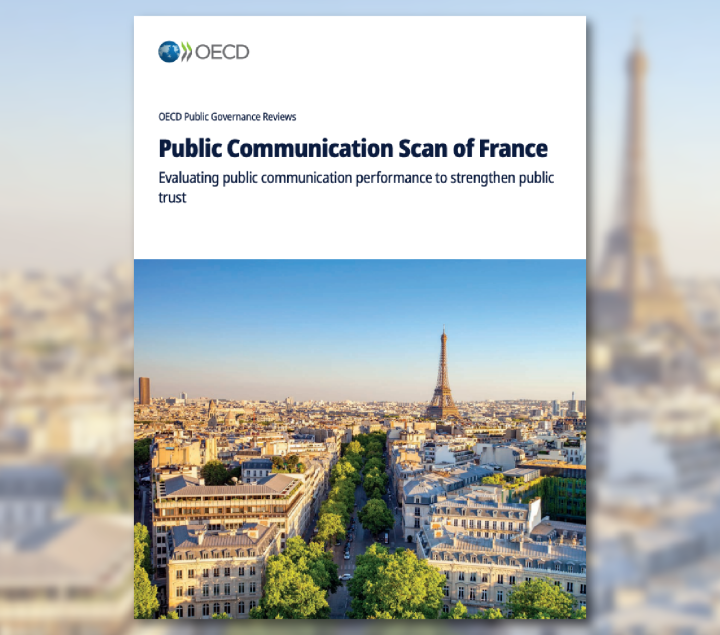
The OECD calls on France to improve evaluation of its communication
Following an audit of the Government Information Service, the Organisation for Economic Co-operation and Development has released a report on public communication in France. A macro-level perspective that highlights the need to evaluate communication.
There is a paradox in the current situation. On one hand, the OECD’s recently published Scan of Public Communication in France, developed in close collaboration with the Government Information Service (SIG), points out that citizens still lack a proper understanding of public policies and that the changes and outcomes initiated and achieved by the government are not sufficiently acknowledged. On the other, the Prime Minister has announced a major scaling-back of government communication, which is expected to reduce public communication budgets by 20% for ministries and by 40% for public agencies.
Public communication is a powerful policy lever
The OECD, which brings together developed market economies, rightly stresses that public communication, “by giving meaning to public policies, making government action more visible and understandable, and maintaining an ongoing dialogue with citizens, is increasingly a powerful policy lever and a driver of transparency, accountability and civic participation that can also help institutions earn the public’s trust”. These are the very objectives around which the Cap’Com network of public communicators works alongside the international organisation on communication both at state level and within local authorities.
The certainty of a positive correlation between transparent political communication and trust in government leads the OECD to note with concern that only a minority of French citizens feel their government clearly explains the implications of public policies.
For those interested in how government communication is organised, the value of this ‘Scan’ of public communication in France lies in its call for stronger evaluation practices. Evaluation is presented as a key tool in achieving the OECD’s goal of building “effective states”.
In France, public communication by the state and its agencies has become more professional, the OECD acknowledges. Reforms introduced since 2018 have focused on improving efficiency, coordination and impact. These efforts in France mirror an international shift towards more strategic communication that is data-driven and better equipped to counter disinformation and declining public trust.
Under current rules, ministries have to produce annual communication plans and include evaluation requirements for initiatives exceeding €50,000. Post-campaign assessments are also mandatory for initiatives exceeding €300,000.
Clarifying goals and assessing political impact
However, according to the OECD analysis, “the implementation of these reforms still needs to be strengthened, particularly when it comes to clarifying strategic goals and linking communication evaluation to political impact”. Evaluation must move beyond surface-level metrics and begin to measure real outcomes and the genuine impact of communication activities. This is crucial both to demonstrate the value added by communication to government and to shield it from budget cuts.
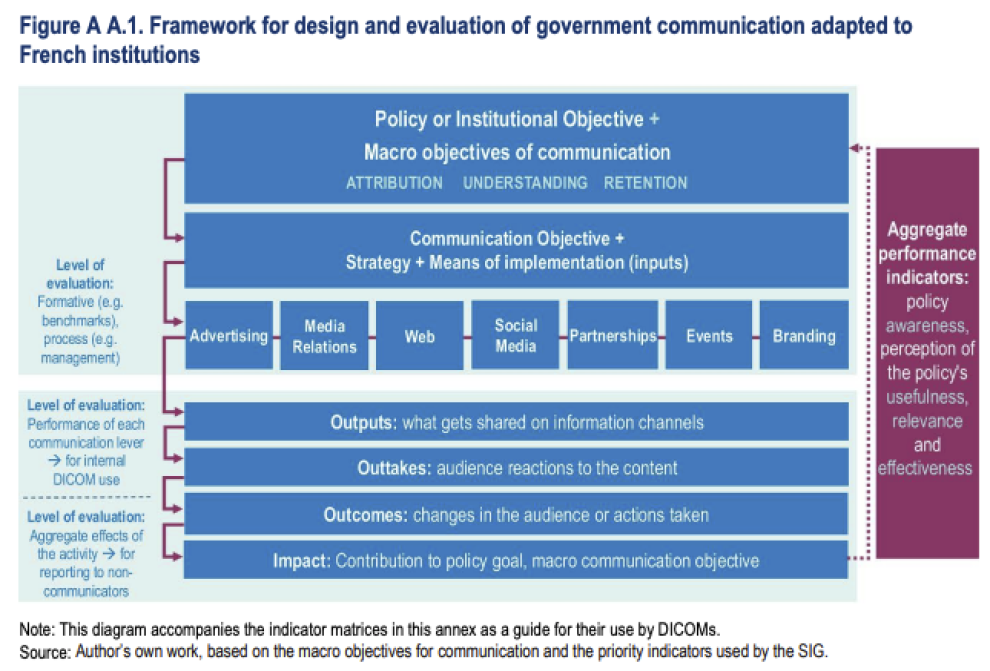
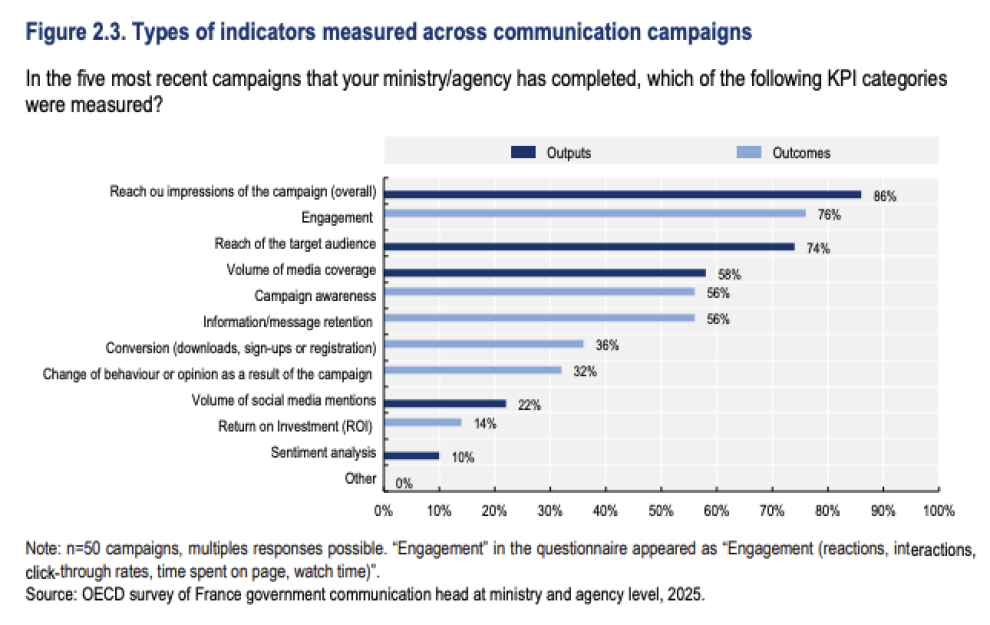
At present, the depth and quality of evaluation vary considerably, revealing wide scope for improvement that could help make communication more effective, more efficient and ultimately more strategic. The data examined in the report show that most evaluation still focuses on output indicators and on metrics linked to the paid components of communication campaigns. By contrast, results and long-term impact are far less frequently assessed, if at all.
Communicators need to draw on established evaluation frameworks to improve how they design and measure their activities. Approaches such as the Theory of Change (ToC), SMART objectives and the project logic model are already used by several OECD governments and leading organisations. “These could help French public institutions evaluate their strategies more rigorously”, the OECD suggests.