

European Universities: telling a shared story across the continent
Caroline Grand, director of communications at the University of La Rochelle, is a member of the European network EU-CONNEXUS, which focuses on the sustainability of urban coastal areas. She shares her feedback on the communications strategy of the alliance, which was launched in 2019 and brings together nine European partner universities.
In his 2017 Sorbonne speech, Emmanuel Macron called for the creation of European universities capable of educating a new generation of Europeans by combining academic pathways, languages and cultures. This vision quickly materialised through a flagship initiative of the European Commission, launched in 2019 under the Erasmus+ programme.
Today, 64 alliances bring together more than 560 higher education institutions across Europe. Their ambition goes beyond cooperation: they aim to progressively build truly transnational universities. This movement is now firmly recognised at European level, with the European Parliament identifying European universities as a key driver for structuring and integrating higher education across the continent.
Yet this ambition raises a fundamental challenge: how can such complex, evolving structures be made understandable, visible and meaningful to their audiences? This is where communication comes into play, not as a support function, but as a strategic lever.
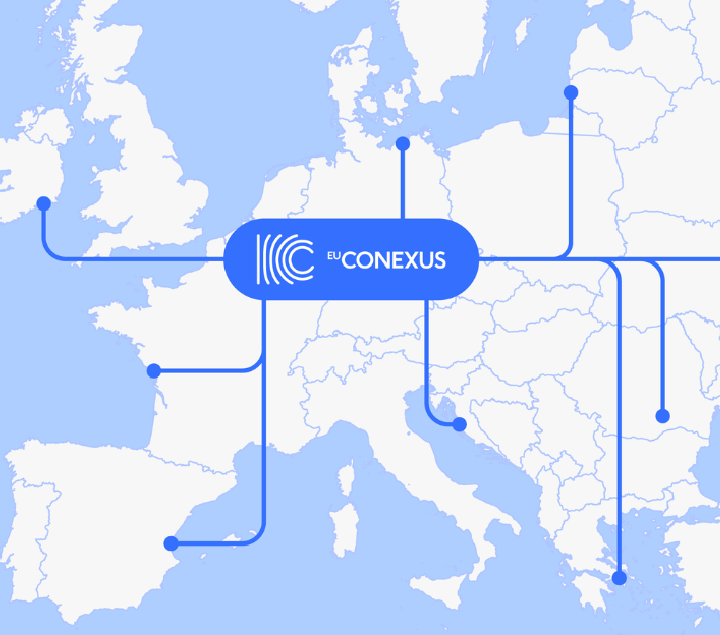
EU-CONEXUS is one of these alliances. Launched in 2019 and initially coordinated by La Rochelle Université, it brings together nine partner universities across Europe: in France, Spain, Croatia, Lithuania, Romania, Greece, Cyprus, Ireland and Germany.
The alliance is structured around a shared research focus on the sustainability challenges facing coastal urban areas. Across this common theme, partners develop joint education programs, research projects and innovation initiatives at European scale.
Like many European alliances, however, EU-CONEXUS faces a core challenge: how to make a structure that is both complex and still evolving tangible and understandable for its stakeholders.

Discussions within the alliance have highlighted several key communication challenges:
- moving beyond awareness to genuine engagement
- making messages clearer for diverse audiences
- strengthening understanding at local stakeholder level
- better identifying and demonstrating the effects of actions
The issue is no longer simply about visibility. It is about fostering understanding and enabling appropriation.
This shift, from visibility to meaning, raises a broader question for communication professionals: how do we move from broadcasting information to creating real impact?
In April 2026, communication leads from the partner universities met in Zadar, Croatia, for their annual in-person meeting, complementing their weekly online exchanges within the EU-CONEXUS Joint Communication Unit, as the alliance prepares to enter its third phase.
The Joint Communication Unit brings together the communication departments of all nine institutions. Established in 2019, it has evolved into a structured space for coordination, production and strategic reflection. It is recognized as a dedicated work package, coordinated by Klaipeda University.
Over time, this network of professionals has developed a shared approach, including common strategy, tools, brand identity and coordinated actions. This collective work reflects a growing level of maturity.
The alliance is now entering a new phase. After an initial launch and a period of structuring, phase 3 marks a moment of consolidation. The focus is no longer on experimentation alone, but on embedding actions within institutions, strengthening ownership and more clearly demonstrating their impact.
In this context, communication is no longer simply supporting activities. It plays a direct role in making the collective project understandable and accessible.
At the same time, this work highlights the need to position communication appropriately. While it helps clarify and amplify the project, it cannot drive engagement on its own. Engagement also depends on clear strategic direction, coherent systems and the active involvement of stakeholders.
Communication’s role is therefore to support, enhance and make visible what already exists. The objective of the Zadar meeting was not to produce more content, but to step back and address a more fundamental question: what is the actual impact of our communication?
As part of the European Commission’s requirements at the end of phase 2, the alliance is developing a more qualitative approach to impact assessment, complementing existing quantitative data.
Rather than relying solely on surveys, the approach combines:
- focus groups with students, academic staff and administrative staff
- interviews with leadership teams and partners
- analysis of existing data such as web, social media and participation metrics
- collection of concrete examples and feedback
The aim is no longer just to measure exposure, but to better understand:
- how the alliance is perceived
- how its value is understood
- what drives or limits engagement
In other words, to move from measuring visibility to understanding impact.
This approach is based on a simple principle: communication impact cannot be assessed without listening to its audiences.
EU-CONEXUS is therefore engaging with a wide range of stakeholders, including students, whether involved or not, academic staff, administrative staff, leadership teams and external partners.
These exchanges are essential to understanding how the alliance is experienced in practice.
The challenges faced by EU-CONEXUS are not unique. They reflect a broader transformation in higher education communication.
European universities are hybrid structures, at once institutional, political and academic. Communicating about them requires clarifying their purpose, aligning strategy and communication and developing concrete, human-centred narratives.
Professional networks also play a key role in this process. Peer exchange is increasingly recognised as essential for making these alliances understandable.

These reflections extend beyond the alliances themselves and are nourished by broader professional communities.
In France, organisations such as Cap’Com, ARCES and ComoSup contribute to these discussions. At European level, networks such as the Club of Venice and EUPRIO provide additional platforms for exchange.
These spaces allow professionals to share practices, compare approaches and collectively reflect on communication challenges in higher education and public organisations. They also contribute to raising the visibility of European universities beyond their immediate circles.
The work carried out in Zadar reinforces a key idea: communication does not merely describe European universities, it helps shape them. By making projects clearer, fostering engagement and connecting audiences, communication plays a direct role in making these initiatives more accessible and meaningful.
For the EU-CONEXUS Joint Communication Unit, the next step will be to translate these insights into practical recommendations to further strengthen communication practices across the alliance. European universities represent one of the most ambitious transformations in higher education in Europe.
Their success will depend not only on their structures, but on their ability to be understood and embraced by their audiences. In this context, communication is not a secondary concern. It is central to making complex projects understandable, clarifying their purpose and enabling individuals to engage with them. This raises a critical question: what do we actually measure when we talk about communication impact? Our role is both simple and demanding: not only to explain, but to understand how audiences perceive and interpret these projects, in order to make them meaningful and, over time, truly shared.
Sources
- Commission européenne. European Universities Initiative.
- Macron, Emmanuel. Initiative pour l’Europe – Discours de la Sorbonne, 26 septembre 2017.
- Ministère de l’Enseignement supérieur, de la Recherche et de l’Espace. Les universités européennes.
- Parlement européen. Rapport sur les universités européennes, 2025.
- EU-CONEXUS. Site officiel de l’alliance.